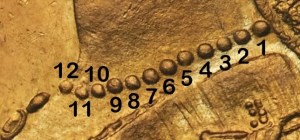
A new variety of Jubilee Head gold half sovereign having only twelve pearls in the Queen’s necklace has been confirmed, and the first examples from the Royal Mint in London have been discovered. Based on size and position of the thirteenth pearl found on the vast majority of coins, it is proposed that this last pearl was not present on the master hub, but was individually punched onto each working die. On rare occasions this extra punch was accidentally neglected, resulting in coins displaying only twelve pearls in the necklace. Examples of twelve pearl varieties are reported for five of the eleven date/mint combinations of the Jubilee Head issue from 1887 to 1893, including 1887 proofs.
Please click here to read the article.

 BNS Research Blog
I have noted the protruberance from the front 12th pearl in past and always assumed and continue to believe this is a die flaw rather than a purposeful round pellet. The fact the size varies from a dot to a blob as illustrated by three pictures in this article is surely evident of a flaw on the die infilling with metal that just happens to be roughly circular rather than intentional punching and a very small scale. We also know from Royal mint reports of the time that there was mass die failure on the Jubilee type Half sovereigns with hundreds of dies in use and one of the weak points seems to me at least, to be the front of the necklace. Perhaps others who are more experienced in manually working with coin production will know and comment more.
Victorian Jubilee Head Obverses found on gold half sovereign coins
Hi James,
This is my view on the subject
The Royal Mint used two different obverse die matrices in the period 1887-1893 from which all the working dies were produced. I will call one die matrix A the other die matrix B.
Type A – This type has the designers initials JEB shown as IEB (imperfect JEB) these initials were on the matrix itself. This type was used on the majority of London Mint half sovereigns in 1887 and some 1890 coins and very rare 1891 & 1892 coins. This matrix was also used to produce the 1889 Sydney coins, some 1891 Sydney coins and all the 1893 Melbourne coins and all Australian proof coins in the period.
Type B – This type produced working dies that had no initials, The coins produced in 1887 in Sydney and Melbourne were produced from this matrix and had their initials manually punched onto the working dies, also a small number of 1887 London Mint half sovereign obverses had the initials manually punched onto the working dies. This matrix without initials continued to be used to produce obverse dies from 1887 until 1893 on the London Mint coins
There are differences between the two matrices, things to look out for are, (probably best to look at high grade coins,) with Type A there is the lack of a connector between the large pearl and the smaller pearl on the earring, also there are two dots punched near the cross on the orb, to the right in the field there is a small dot, a larger dot is punched onto the last visible denticle left of the cross before it becomes merged within the border.
I am of the opinion that the thirteenth pearl, which is partly hidden by the twelfth pearl, appeared on both matrices but was flatter and had less detail. Definition was lost when transferred to the working dies, and this when combined with the quality of strike and die wear could result in the appearance of their only being 12 pearls. Have a look at one of my coins on the Heritage Coin Auction site, a 1890 half sovereign from a Type A matrix sold on 6th Feb 2015 NGC 3889914-012 AU58 you can see what looks like a small pimple this is not a pimple but a small remaining part of the original design.
The punching of the initials onto the working dies in 1887 was unusual, probably to placate the designer. In 1879 following the death of T J Minton, the Royal Mint decided to include most of the details on the die matrices, including the date, of course the colonial mint marks continued to be punched in manually as it was more economical than to create specific matrices for the colonial mints as the mint mark was punched between the date, and due to the fact that only small quantities of working dies were required. I find hard to believe they would have intentionally punched an additional part of a pearl on some of the working dies as there would be no need to do so.
Best regards
Brian
Thanks for the interesting comments. I have substantial replies to make which can’t be said here in just a few sentences, so I intend to post a follow-up article later to address these ideas. I will wait a couple of more weeks to see if anyone else has pertinent comments before posting.
JK