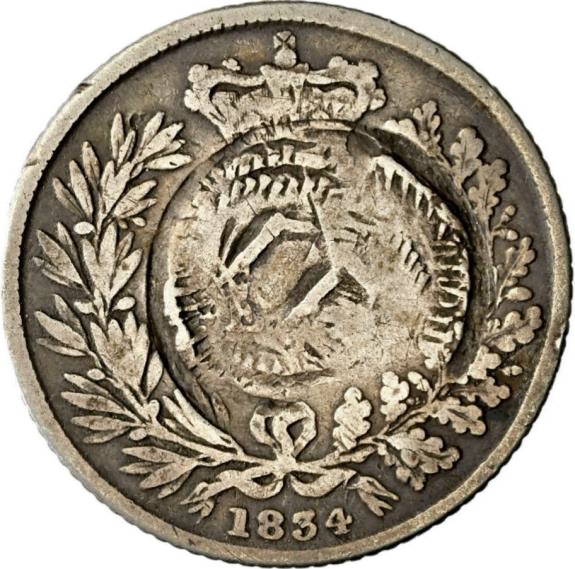
This research note presents a newly confirmed mint-stage striking anomaly on an 1834 William IV sixpence, authenticated through laboratory testing at Brunel University London and the University of Oxford. The coin displays severe deformation across both sides, including terraced doming, loss of the SIXPENCE legend, and evidence of repeated in-die striking. SEM–EDX and optical profilometry confirm that the distortion occurred during manufacture at the Royal Mint rather than through post-mint alteration or later damage.
Mint errors of this severity are rarely recorded in William IV silver coinage, particularly from the early steam-press era. No equivalent example has been identified in Royal Mint documentation, British Museum catalogues, or major auction records, marking this specimen as a rare witness to early mechanised minting failure. The study demonstrates the value of integrating laboratory techniques with traditional numismatic analysis to distinguish genuine mint-stage anomalies from post-mint damage with high confidence.


Thank you to the BNS editorial team for the opportunity to share this research note.
This study forms part of an ongoing programme exploring historic minting anomalies through an integrative methodology combining advanced imaging, laboratory-based materials analysis, and contextual archival research.
Further datasets, imaging outputs, and comparative materials will be released through IA STUDIO – an independent research initiative connecting scientific examination, digital documentation, and interpretive approaches within numismatic and cultural heritage study.
This investigation of the 1834 Sixpence represents the first study developed within this evolving initiative.