The City of London, Lime Street Hoard(s), 1881 – Hugh Pagan

The present note provides the first published discussion and listing of 232 coins of Edward the Confessor found in Lime Street, London EC3, during the year 1881, accompanied by up to 14 coins of his immediate predecessors and 6 coins of Harold II. The coins involved were acquired by the coin collector Thomas Bliss (c.1848-1914), and Bliss’s meticulous listing of them in his manuscript catalogue of his collection enables the coins to be traced partly in the sale catalogue of Bliss’s own collection, sold by Sotheby’s in 1916, and partly in the sale catalogues of the relevant portions of the great collection made by the London solicitor Hyman Montagu (1844-1895), sold by Sotheby’s shortly after Montagu’s death. The fact that coins of Edward the Confessor were found in such quantity in Lime Street in 1881 has remained unknown both to numismatic scholars and to those interested in the history and archaeology of Anglo-Saxon London over the last 145 years. Readers

read more The City of London, Lime Street Hoard(s), 1881 – Hugh Pagan
The Langford, Bedfordshire, Hoard 2016, and the Leigh-on-Sea, Essex, Hoard 1892 – Hugh Pagan

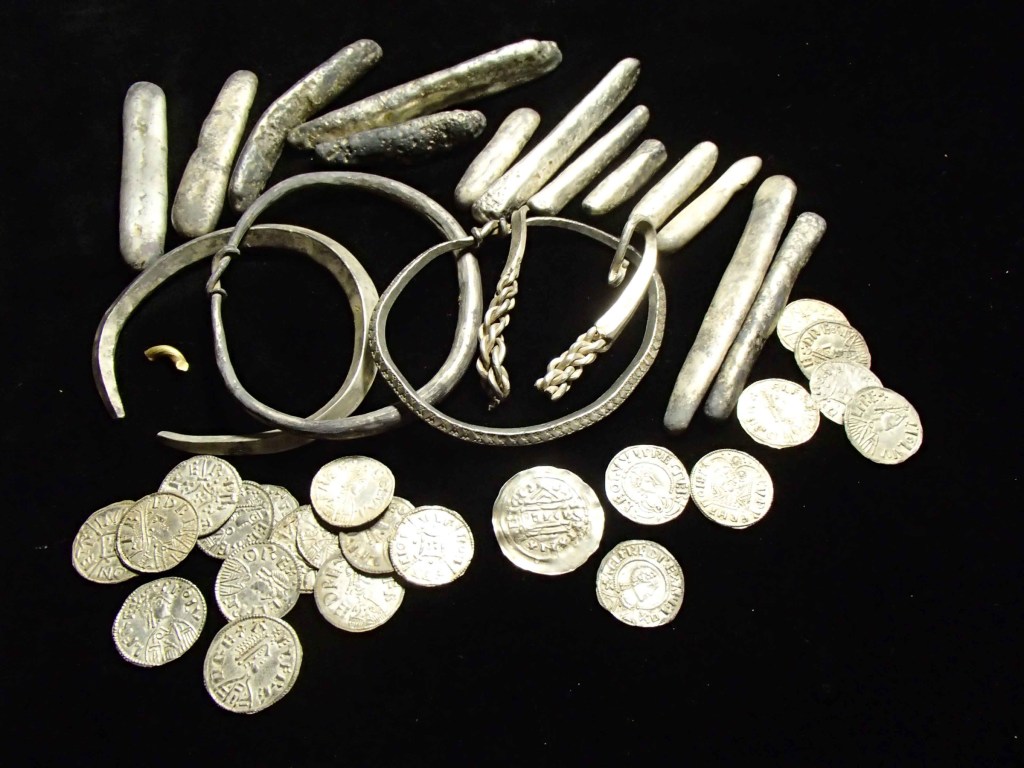
This records two very similar hoards of Anglo-Saxon coins containing coins of Alfred of Wessex and of Archbishop Plegmund of Canterbury, one found at Langford, Bedfordshire, in 2016, and the other at Leigh-on-Sea, Essex, in 1892, and discusses the evidence for their dates of deposit. The content of the Langford hoard has not as yet been formally published, and the summary listing of it offered here will be helpful for the wider numismatic community.

A Millenium of Numismatics at Hexham Church – Gary Oddie

This Blog began as a simple description of three skilfully engraved silver coins, each showing a view of Hexham church and dated 1830 and 1833. Each of the pieces has an engraved name, but with too many local possibilities, they are unlikely to be identified with certainty. Whilst searching for events at the church during this period, a completely unexpected numismatic connection was made. On Monday 15 October 1832 the Hexham hoard of about 8,000 Northumbrian Stycas was discovered. The hoard had been deposited c.865. At the time the discovery was reported in local newspapers across the country. The discovery and contents of the hoard were published in 1833. The first specific appearance of the hoard in numismatic literature was in J.D.A. Thompson’s Inventory of British Coin Hoards of 1956. The dates on the engraved coins may be just the result of a local engraver creating mementos or may have some significance relating to the closure of the church for

read more A Millenium of Numismatics at Hexham Church – Gary Oddie

BNS Hoards Conference, Sat. July 15th, Ashmolean Museum, Oxford – Speakers and Topics

Image Credit: The Portable Antiquities Scheme

At this all-day Conference, focused on the British Isles, leading figures working on coin hoards and related material will look at recent discoveries and what we can learn from them along with the latest thinking on how coinage came to be hoarded and then hidden. It will then consider the latest techniques being used to recover and interpret hoards and to make available hoard data for researchers and collectors. Tickets still available!

“MCHBI” – A BNS Online Map Application for Medieval Coin Hoards in Britain and Ireland – Rob Page

The British Numismatic Society is pleased to announce the availability of a new feature on its website which allows users to explore Medieval Coin Hoards in Britain and Ireland (“MCHBI”). This brief article shows how to access the website and some examples of the products that can be generated.  The facility should prove of interest to numismatists, historians, archaeologists and metal detectorists.  With nearly 1900 hoards uploaded and increasing daily it is already the largest compilation of Medieval hoard data from Britain and Ireland, and will be continuously added to in order to keep it as up-to-date as possible.