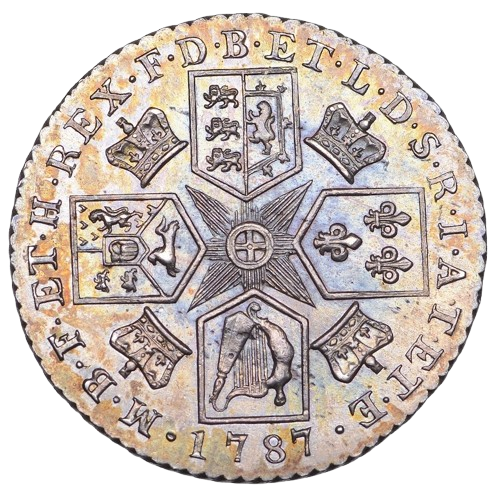
Due to advances in the production of punches, and consequently dies, for the sixpence and shilling coinage of 1787, the reverse of the shilling exhibits little variation beyond the semée of hearts and stops. However, despite being fully lettered, the punches lacked both the hearts and the harp strings. This resulted in the strings being manually carved into each die, producing considerable minor variation which, aside from the number of strings, has typically been overlooked. This study instead examines the angle of the strings, highlighting a previously undocumented reverse type, here termed the Vertical String Type.


An interesting and useful article.
I don’t think it’s useful to extrapolate populations from such a small sample, without knowing how it was assembled and what bias occurs in that sample.
Another sample might show a completely different proportion.
You’re absolutely right, statisical bias is more than likely in place with my estimation, however it’s at least a current working estimate, which will change as my project furthers.
Ashley, well done on spotting this variety, and congratulations on your first Blog article!
Thank you Rob! It’s a part of a much larger project I have been working on, predominantly whilst I was in the US, which involves a full die study and later 3D renderings of the tooling equipment which has been since destroyed!
Clear and convincing discovery of vertical harp string variety.
On the total number of 1787 shillings, the relevant Manville and Glasser BNS article , 74 p84-101 , gives detailed support for your 746480 estimate